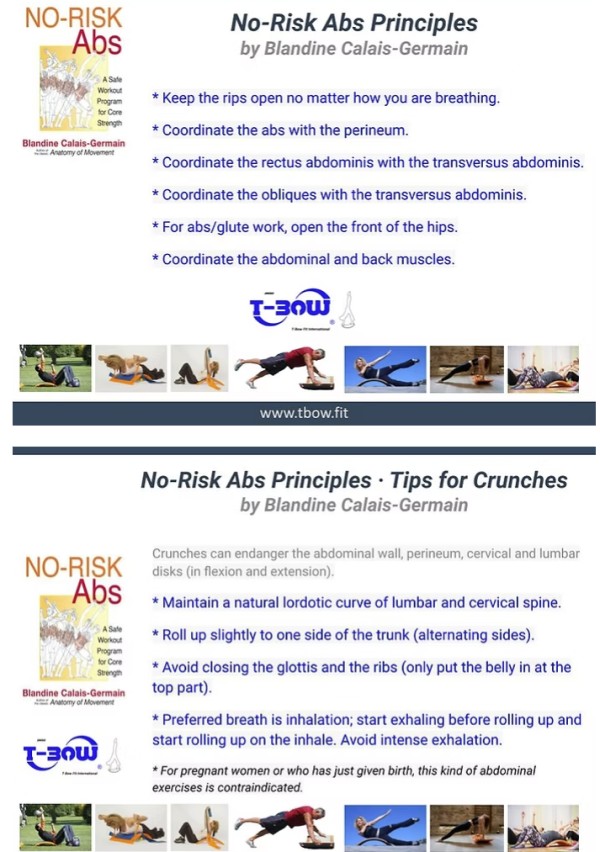
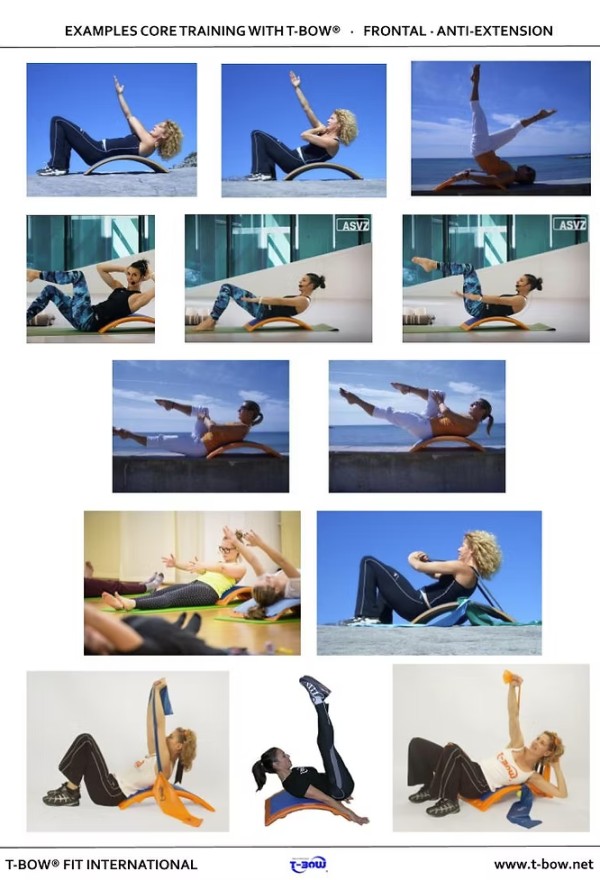
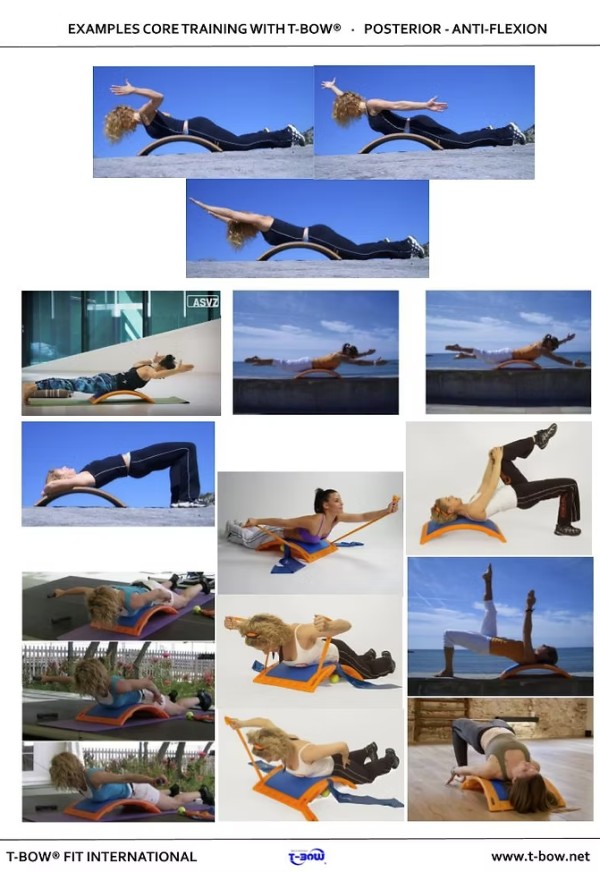
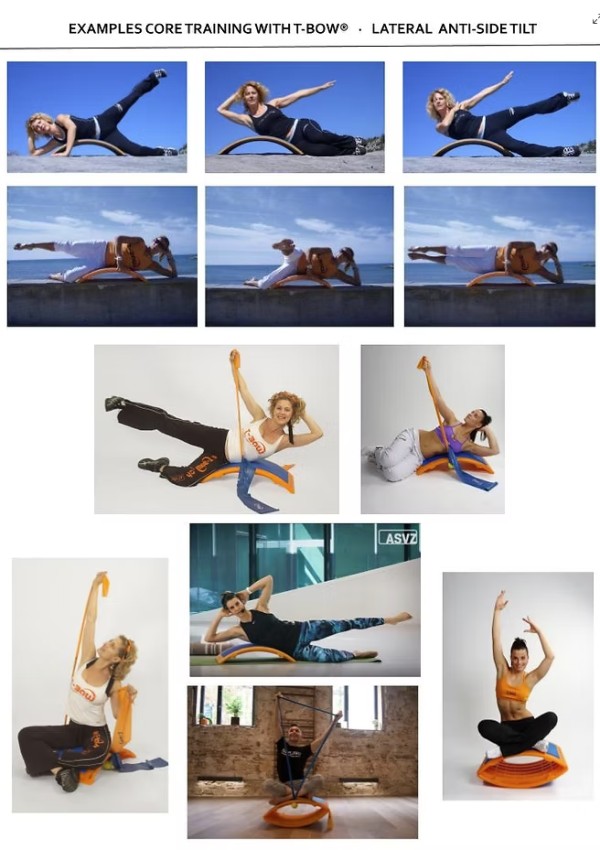
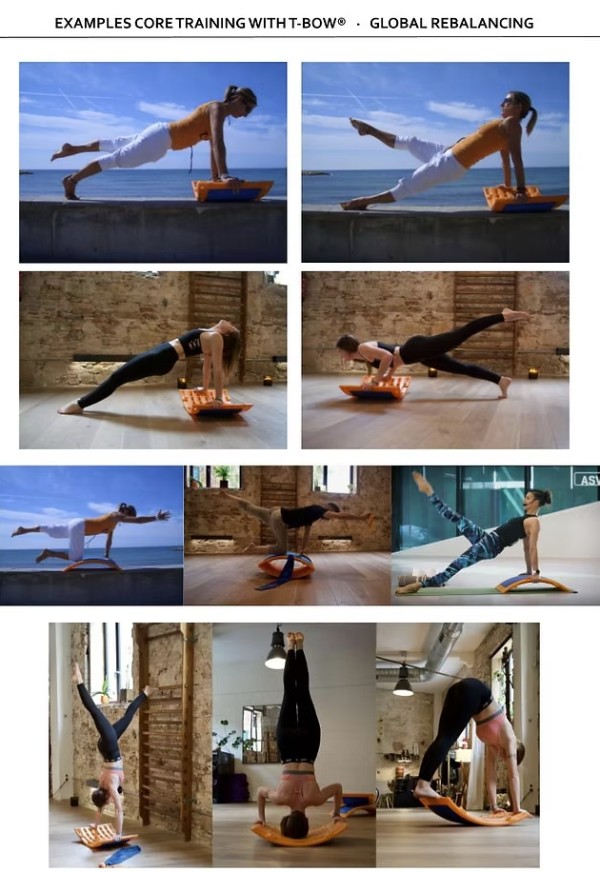
The arch of the T-BOW®, in a stable position, supports the spine in such a way that it can be exercised in degrees of amplitude greater than a flat surface (greater range of movement) and, based on the natural anatomical curvature of the lumbar lordosis, in a stable position throughout the movement range or static posture.
Simultaneously, the reactivity of the T-BOW® (with a mat on the convex part that is comfortable and very sensitive to body contact) improves the kinesiological fixation of the back, the possibility of a very stable localization of the lumbar lordosis and rapid accuracy of posture and movement; unlike softer and less reactive surfaces (bosu, balance dome of Technogym or fitball types) that cause a sinking of the back when supporting it and slower postural feedback, limiting fine postural-movement adjustment.
The trunk can be strengthened at different levels, mobilizing different segments of the spine by positioning the hip at different heights of the T-BOW® arch; thus selectively influencing parts of the musculature:
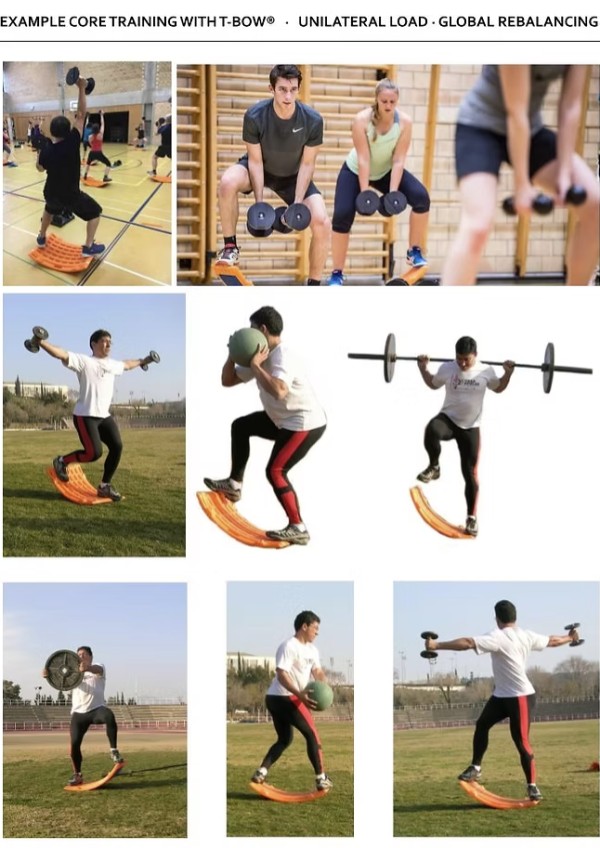
The load varies depending on where the hip rests and whether the trunk or the hips/legs are mobilized; also, depending on how the body itself is used, the T-Bands (each anchor hole of the elastic bands creates different lines of force and increasing-decreasing-constant tension) or free weights (their place of placement on the body or segmental mobilization causes different overloads) or medicine ball (1-2 hand grip, initial position, and throwing impulse path and final action).
A training with asymmetric or unilateral load at the level of the trunk, for example with the traction of a T-Band or elevation of a dumbbell, especially when relatively small overloads are applied, allows the activation of deeper muscle groups of the intervertebral musculature of the back that give stability to the spine, maintaining a harmonic alignment of the vertebrae and intervertebral discs, with instant rebalancing.
With the T-BOW® in a highly reactive swing position, you train on dynamic surfaces that add variety to core training; achieving a smaller muscular localization and a greater optimization of the global rebalancing-reactivity of all the stabilizing muscles of the trunk.
In these extremely reactive T-BOW® (unstable position) balance situations, with a very fast and fine postural and movement adjustment, the use of asymmetrical or unilateral loads, for example with dumbbells, takes trunk strengthening to the highest level of strength and precision.
Once it has been studied whether or not it is necessary to strengthening the trunk, the personalized selection of exercises in stable and unstable positions of the T-BOW® is essential to achieve an effective optimization of the strength-stability of the trunk-pelvis complex, both for the individual who seeks health in their daily activities as for the elite athlete.
Likewise, the following factors must be considered, as a minimum:
-
Postural disposition: a) anti-flexion, anti-extension, anti-rotation and anti-lateral tilt (bilateral/unilateral); b) supine/prone, lateral and vertical/inverted (extended/flexed segments).
-
Execution surface: a) flat / +- arched, b) level of reactivity (+- soft).
-
Static, dynamic (+- slow-fast, +- elastic, +- ballistic, +- reactive) and combined static-dynamic (fixed/mobile zone) muscular conditions.
-
Overloads oriented towards maximum strength, rapid strength or endurance strength (with one’s own body, free weights, medicine balls, rubber bands,…).
-
Balance and rebalancing situations (biomechanical and sensory variations).
-
Coordinative variations of execution (motor control, spatial implementation and temporal adequacy) of the trunk-pelvis complex.
-
Space-time and rhythmic optimizations.
-
Decision making and unforeseen situations.
-
Associated breathing techniques.
-
Static-dynamic relaxation and regeneration adjuvant supplements.
-
Static-dynamic muscular balance of the most important muscle groups, protagonists-antagonists, of the trunk-pelvis complex.
-
Tendinous-articular unloading, joint mobility and muscular elasticity at a local and global level of the trunk-pelvis complex.
Applicability: in group fitness classes, personal training, elite sports preparation, physiotherapy, postural and injury rehabilitation.
Bonacina S (2005). Das umgasende Training mit dem multifunktionellen rainingsbogen. Training Tips von Sandra Bonacina. Fitness Tribune, 93: 112-113.
Calais-Germain B (2008). Abdos sans risque. Éditions Désiris.
Chulvi Medrano I and Masiá Tortosa L (2014). Entrenamiento de inestabilidad. Bases para el correcto entrenamiento. Enfoque sobre la columna lumbar. Edic. Cardeñoso.
Rasch PJ and Burke RK (1985). Kinesiology and Applied Anatomy. The science of human movement. Lea and Febiger.
Seirul·lo Vargas F (1986). Entrenamiento coadyuvante. Apuntes de medicina deportiva, 23, 38-41.